An assessment or self-assessment test provides a wealth of information about an employee’s skills, practices or behaviours.
But once the questionnaire has been completed, one key question remains:
What will the report actually offer the participant?
📌 Key points to remember
- IRIS is a personalised assessment, designed on the basis of real-life situations and targeted skills.
- AI enables the assessment to go beyond a simple score by analysing each participant’s responses in detail.
- The report transforms the results into concrete development recommendations, which can be put to immediate use as the participant progresses through the programme.
- The report is generated in a matter of seconds, ensuring a smoother, personalised and immediately actionable experience.
A score, a few graphs or a standardised summary provide an initial overview of the results. But to truly support progress, we need to go further: explain the responses, identify strengths, highlight areas for development and, above all, suggest concrete ways to improve.
It is precisely at this stage that artificial intelligence can now transform assessment practices.
The term assessment can refer to a wide range of evaluation methods: tests of skills, aptitudes and motivation, role-plays, observations and questionnaires.
A self-assessment test, on the other hand, invites the participant to assess their own position in relation to defined practices, behaviours or skills.
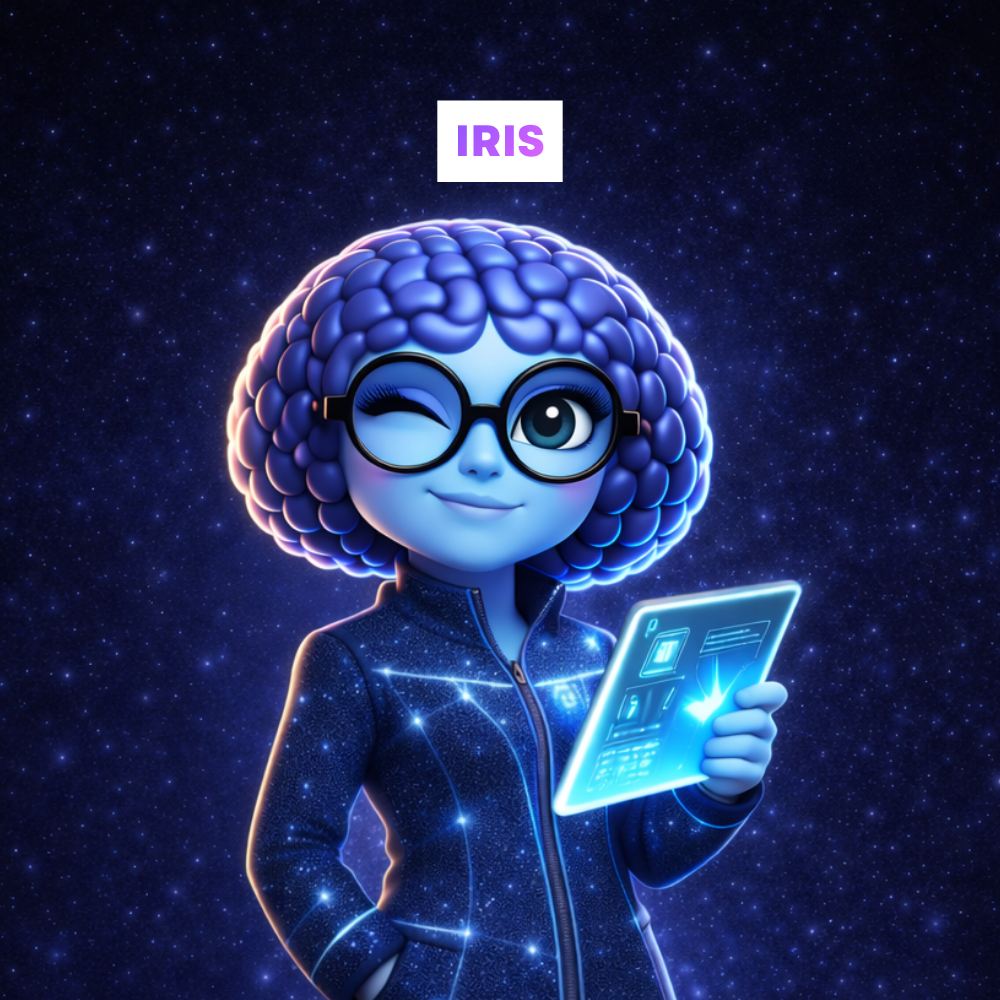
IRIS takes this approach a step further: our AI Scan is a personalised assessment, built around real-life situations and the skills the organisation genuinely wishes to observe and develop.
The aim is therefore not to establish a general profile of the participant, but to gain a better understanding of their approach to specific professional situations and to transform their responses into directly actionable development opportunities.
The AI Scan report: much more than just a result 📑
Assessment tools have greatly simplified the process of evaluating skills.
A participant completes a questionnaire, the results are analysed, and a report can then be provided to them.
But not all reports are created equal.
Depending on the tools used, the report may mainly take the form of:
- scores by skill;
- charts;
- comparisons with an average or a benchmark;
- predefined summaries;
- profile categories.
These elements are useful for assessing a participant’s current level.
But they do not readily answer a question that is nonetheless essential:
‘In practical terms, what do I need to develop now?’
This is where the real difference lies between a report that simply presents data and one that genuinely supports skills development.
The limitations of overly standardised reports 🟥
Let’s take an example.
Two managers complete the same self-assessment test on their managerial style. They both achieve a score of 6.5/10 for communication. At first glance, their results appear identical. However, their development needs may be completely different.
The first may struggle to provide feedback that is clear enough.
The second may communicate very well on a day-to-day basis but avoid sensitive conversations or situations where there is disagreement.
Same score.
But not the same development needs.
A report that is too standardised therefore risks providing a similar assessment for these two profiles, whereas a more detailed analysis of the responses reveals crucial differences.
For a Training Manager, the challenge is no longer simply to obtain results.
It is to obtain an assessment that is precise enough to genuinely guide the next steps in the development process.
Greater customisation when analysing results ✨
This is probably one of the most interesting contributions of artificial intelligence.
Rather than automatically assigning a score to a predefined comment, AI can analyse all of the participant’s responses and how they relate to one another.
In this way, it can highlight:
- their strengths;
- their dominant tendencies;
- areas requiring attention;
- certain inconsistencies in their responses;
- their key areas for development.
The report is therefore no longer solely linked to a single result category.
It becomes more closely linked to the participant’s own response profile.
This personalisation results in a more relevant and engaging feedback: the participant can more easily recognise themselves in the analysis presented to them.
From findings to recommendations 👀
This is another key point. Many reports help answer the question: ‘Where am I at?’ but do far less to address: ‘And now, what should I do?’
However, for a training programme, it is precisely this second question that is crucial. A good report must be able to turn an observation into avenues for development.
For example: You tend to put off giving feedback when the situation is sensitive.
The information becomes much more useful if it is accompanied by a recommendation:
Work on preparing for difficult conversations by structuring your message around the facts you’ve observed, their impact and the request you wish to make.
We then move: from the score → to the analysis → and then to action.
For the participant, this difference is significant.
For the Training Manager too: the results can become a valuable resource for tailoring the rest of the training programme.
Get your refunds almost straight away with Iris ⏰
The speed of reporting is also a key consideration.
Depending on the solutions and tools used, there may be a certain delay between the completion of the questionnaire and the provision of a full report.
However, the longer the delay, the greater the gap between the moment the participant reflects on their practices and the moment they see the analysis.
With Iris, our AI Scan, this time is significantly reduced.
The analysis is carried out as soon as the questionnaire is completed, enabling a report to be produced in a matter of seconds.
The benefit is not merely organisational.
It is also educational.
The participant has just responded to the scenarios presented, and their choices are still fresh in their mind: they can immediately put their answers into context with the analysis provided.
More comprehensive reporting without making the system any more complicated 💌
For a Training Manager, the challenge is often the same: to offer a personalised experience whilst rolling out the programme to a large group of people.
The more participants there are, the harder it can be to ensure that the feedback remains sufficiently detailed and personalised.
Artificial intelligence makes it possible to change this equation.
A single questionnaire can be sent to dozens or even hundreds of staff members, whilst generating an analysis tailored to each individual’s responses.
It then becomes possible to combine:
the scalability of a digital tool with the depth of a much more personalised report.
IRIS: the AI scanner that brings answers to life 🎤
This is precisely the aim ofIRIS, our AI scan.
Once the responses have been collected, the tool analyses them to generate a personalised and immediately actionable report in a matter of seconds.
The report does not merely present the results.
In particular, IRIS highlights:
- the participant’s strengths;
- behaviours or attitudes to monitor;
- areas for improvement;
- skills to develop;
- practical recommendations for progress.
The aim is therefore not to replace the assessment or self-assessment test.
IRIS enhances what happens next✅
For the Training Manager: moving from reporting to development. The difference may seem subtle. Yet it is fundamental.
A report enhanced by IRIS seeks, above all, to answer three questions:
What do the responses reveal?
What would the participant benefit from developing?
How can they begin to make progress?
For the Training Manager, this enables them to move more quickly towards what really matters: the pedagogical use of the results.
The feedback can, in particular, help to:
- tailor certain training content;
- identify the priority skills to work on;
- inform a debriefing session;
- prepare individual support;
- help each participant define their own development goals.
IRIS becomes the starting point of the learning journey.